


You may also like
-
Composition with Large Red Plane Poster
Pieter Cornelis Mondriaan · 1921 · Geometric abstract art print with a large red plane and crisp black grid
Poster from 69 kr · Framed from 122,67 kr
Regular price From 46,00 krRegular price -
Composition with Large Blue Plane Poster
Pieter Cornelis Mondriaan · 1921 · Geometric De Stijl art print with a large blue plane and crisp black lines
Poster from 69 kr · Framed from 122,67 kr
Regular price From 46,00 krRegular price -
Composition in White, Red, and Yellow Poster
Pieter Cornelis Mondriaan · 1936 · Geometric art print balancing white space with crisp black lines and primary blocks
Poster from 69 kr · Framed from 122,67 kr
Regular price From 46,00 krRegular price -
Place de la Concorde Poster
Piet Mondrian · 1941 · Geometric abstract poster balancing a black grid with red, yellow, and blue planes
Poster from 69 kr · Framed from 122,67 kr
Regular price From 46,00 krRegular price


-

"Very nice Posters. The quality is amazing and we received it very quickly !"
-

"A shop to visit absolutely. Huge selection of posters. We spent more than an hour there !"
-

"Perfect to find gift. Price are very good. An they can frame and pack it on site"
About the Artist
Pieter Cornelis Mondriaan was a Dutch pioneer of geometric abstraction and a central figure in the De Stijl movement. By 1920, he had developed his distinctive neoplasticist style, using straight lines and primary colors to express a search for universal harmony and order in the wake of early twentieth-century upheavals.
Mondriaan's innovations marked a turning point in modern art, influencing generations of artists and designers. For those interested in famous artists, his work is a touchstone of abstract visual language that continues to inspire contemporary aesthetics.
The Artwork
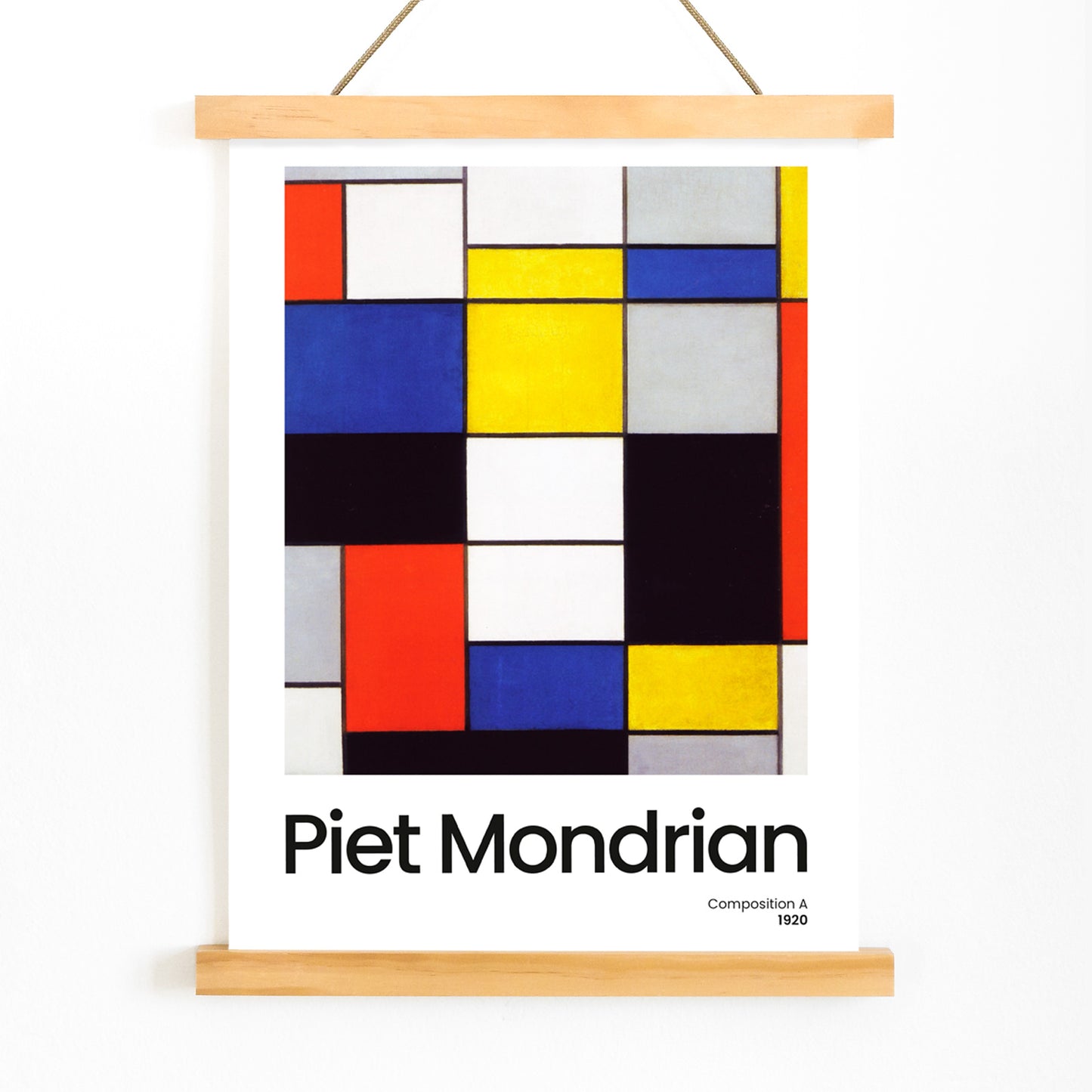
Created during a period of artistic transformation after World War I, Composition A reflects Mondriaan's quest to move beyond representational art and construct a visual language rooted in balance and clarity. This work embodies the ideals of De Stijl, a movement dedicated to reducing art to its essentials in pursuit of a universal harmony.
Rather than depicting the external world, Mondriaan sought to create an image of order and rationality that could resonate across cultures and eras. The artwork stands as a testament to the era's optimism about abstraction as a means of rebuilding and reimagining society.
Style & Characteristics
The composition features a white background structured by bold black vertical and horizontal lines, forming an irregular grid. Select rectangles are filled with vivid primary colors—red, blue, and yellow—while others remain white, creating a sense of openness and rhythm.
Edges are sharply defined, and the deliberate asymmetry generates visual tension and dynamic balance. The overall mood is calm yet lively, making this piece a classic example of geometric abstraction for admirers of abstract posters and modernist design.
In Interior Design
This Mondriaan art print is especially suited to interiors that emphasize clean lines and minimalism, such as Scandinavian or mid-century modern spaces. Its structured composition pairs well with neutral palettes and natural materials, allowing the primary colors to serve as bold accents.
Consider echoing one of the artwork's hues in textiles or accessories while maintaining a backdrop of white, black, or light wood. The print also integrates seamlessly into Bauhaus inspired decor, providing a striking focal point without overwhelming the room.