


You may also like
-

The Current Standpoint of the Mahatmas Poster
Hilma Af Klint · 1920 · Geometric art print featuring circles and triangles in bold black and white symmetry
Poster from 69 kr · Framed from 122,67 kr
-

Buddha Standpoint In Early Life Poster
Hilma af Klint · 1921 · Meditative abstract art print with a bisected black and white circle on beige
Poster from 69 kr · Framed from 122,67 kr
-

Judaism and Paganism Standpoint Poster
Hilma af Klint · 1920 · Mystical geometric art print with crisp black symbols balanced on a calm beige ground
Poster from 69 kr · Framed from 122,67 kr
-

Doves No. 2 Poster
Hilma af Klint · 1915 · Lyrical abstract art print with dove symbolism and pastel-toned geometric forms
Poster from 69 kr · Framed from 122,67 kr


-

"Very nice Posters. The quality is amazing and we received it very quickly !"
-

"A shop to visit absolutely. Huge selection of posters. We spent more than an hour there !"
-

"Perfect to find gift. Price are very good. An they can frame and pack it on site"
About the Artist
Hilma af Klint was a Swedish artist whose innovative approach to abstraction emerged from her deep engagement with spiritualism and theosophy. Working within a group of women known as The Five, she sought to express ideas and visions that transcended the visible world. Today, af Klint is celebrated as a pioneering figure in early modern art, inspiring those interested in groundbreaking artists and the intersection of art and mysticism.
Her practice was shaped by a desire to visualize the unseen, using art as a means to explore consciousness and spiritual realities. This makes her work particularly meaningful for viewers drawn to symbolism and reflective art.
The Artwork
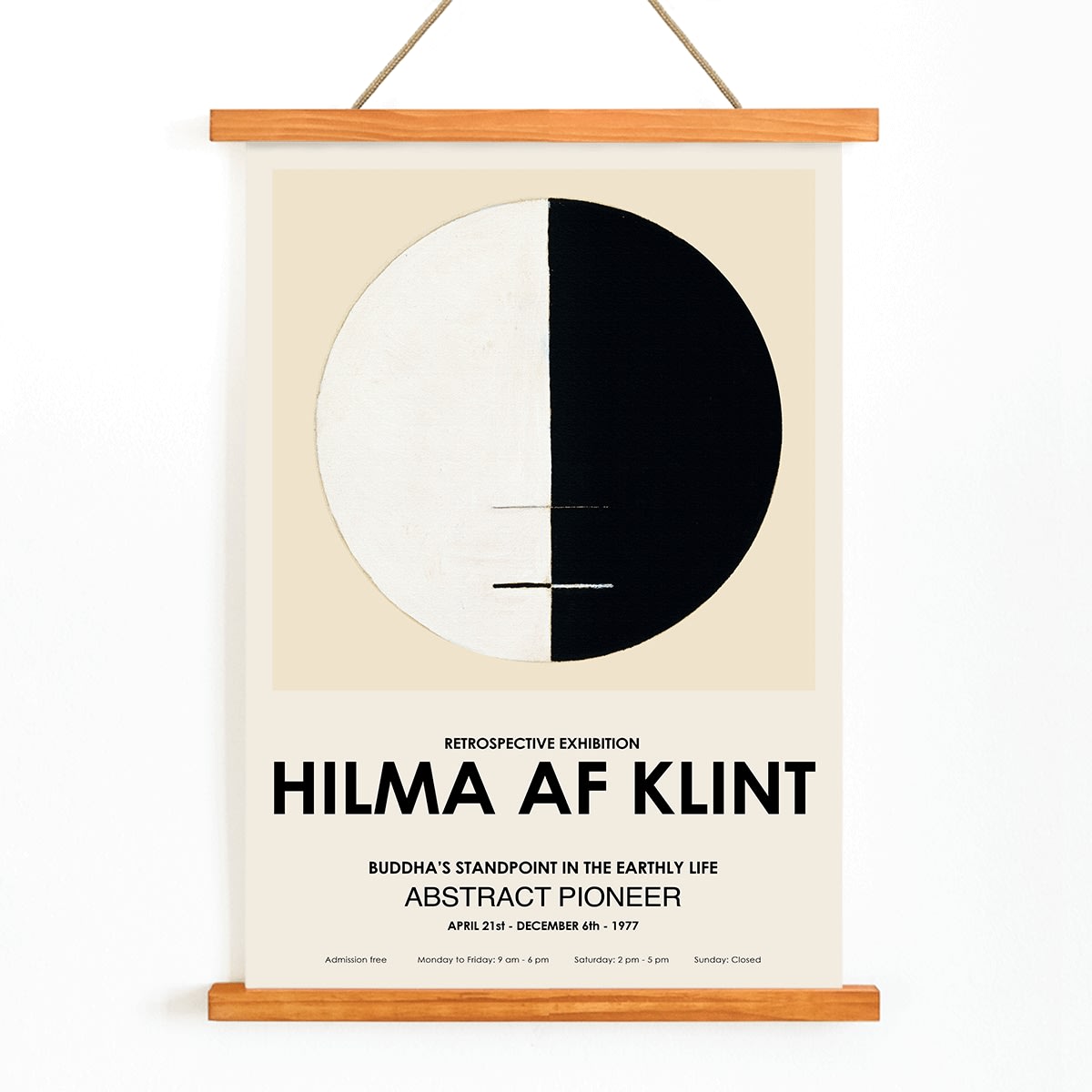
Created in 1917, Buddhas Standpoint in the Earthly Life reflects af Klint’s exploration of spiritual philosophies during a transformative period in her career. The title suggests a contemplative approach to existence, influenced by Buddhist perspectives on presence and awareness. This piece was conceived as part of a larger series of works intended for a spiritual temple, emphasizing its role as a meditative object rather than a decorative one.
In the context of early twentieth-century art, af Klint’s diagrammatic abstraction challenges the dominant narrative of modernism by foregrounding spiritual inquiry. The artwork resonates with the themes found in esoteric and symbolic art, offering a visual language for inner experience.
Style & Characteristics
The image is defined by a precise circular form at its center, rendered with sharp black lines against a soft, off-white background that resembles aged paper. The composition is symmetrical and orderly, with a sense of calm created by the ample negative space surrounding the central motif. The restrained palette of black and beige enhances the contemplative mood, while the geometric clarity gives the piece a timeless, almost diagrammatic quality.
This minimalist approach situates the work between early abstraction and meditative design, making it an ideal addition to a collection of abstract prints or black and white art.
In Interior Design
This art print brings a sense of tranquility and focus to interiors such as living rooms, studies, or meditation spaces. Its balanced geometry and subtle tones complement Scandinavian, Japandi, and minimalist styles, as well as curated vintage print displays.
Pair the artwork with natural materials like linen, light wood, and ceramics to echo its gentle palette, and use black accents in frames or furnishings to reinforce its graphic presence. Positioned above a console or near bookshelves, it serves as a quiet focal point that encourages contemplation.