


You may also like
-

Fern Poster
Anna Atkins · 1850 · Classic cyanotype fern print with crisp white fronds on deep blue
Poster from 69 kr · Framed from 122,67 kr
-

Lastrea Spinulosa Poster
Anna Atkins · 1850 · Fern cyanotype print with luminous white fronds on deep Prussian blue
Poster from 69 kr · Framed from 122,67 kr
-

Lastrea dilatato Poster
Anna Atkins · 1850 · Fern cyanotype botanical print with airy fronds set against saturated blue
Poster from 69 kr · Framed from 122,67 kr
-

Woodwardia virginica Poster
Anna Atkins · 1850 · Iconic cyanotype fern print with crisp frond silhouettes on deep Prussian blue
Poster from 69 kr · Framed from 122,67 kr


-

"Very nice Posters. The quality is amazing and we received it very quickly !"
-

"A shop to visit absolutely. Huge selection of posters. We spent more than an hour there !"
-

"Perfect to find gift. Price are very good. An they can frame and pack it on site"
About the Artist
Anna Atkins was a British botanist and pioneering photographer whose innovative work bridged the worlds of science and art. In the mid-19th century, she utilized the cyanotype process to document plant specimens, producing some of the earliest photographic books and establishing a new standard for botanical illustration.
Her photograms, made by placing plants directly onto light-sensitive paper, are celebrated for their clarity and poetic simplicity. Atkins’s contributions continue to inspire collectors of early photography and those interested in the intersection of science and visual culture.
The Artwork
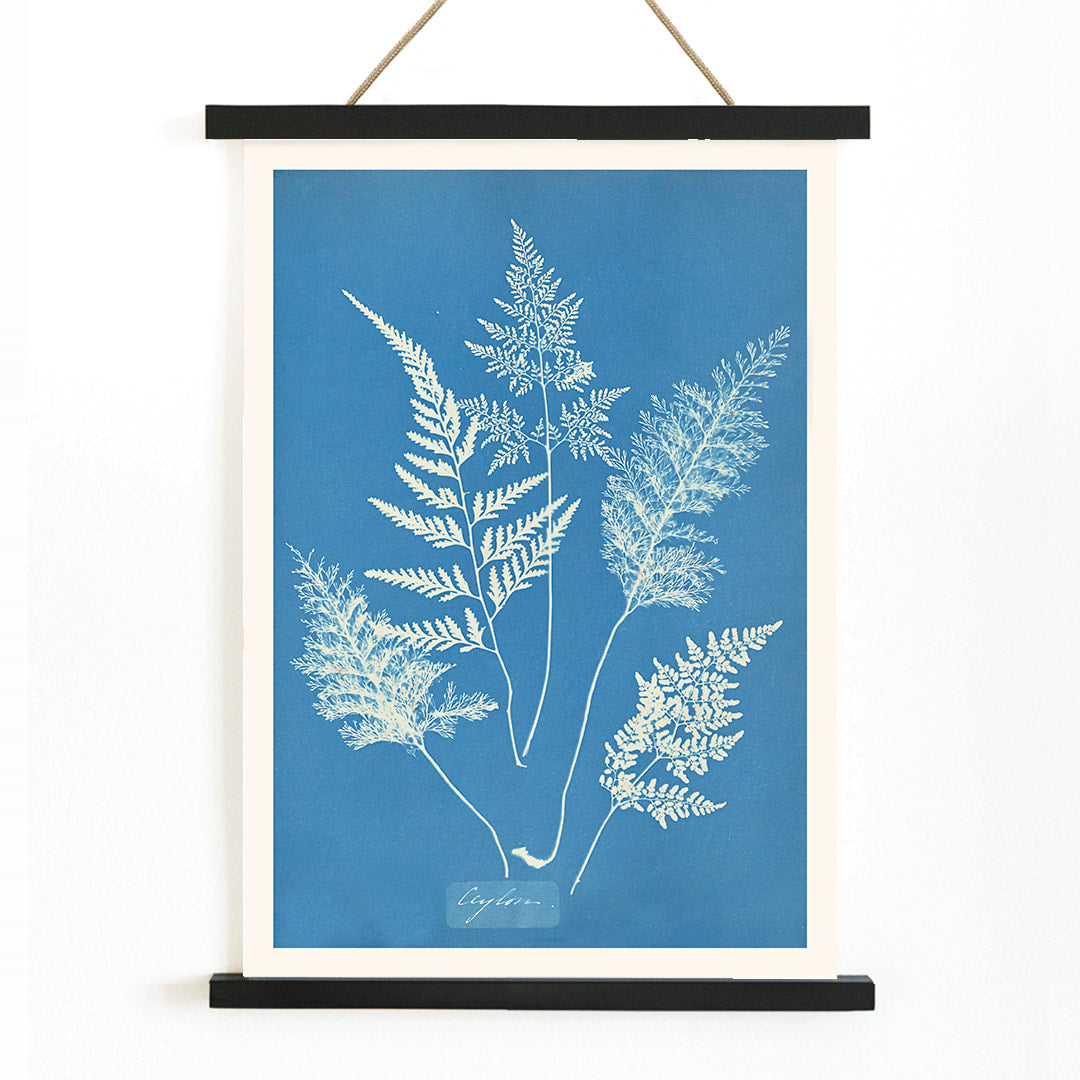
This cyanotype print, titled Ceylon, reflects the Victorian era’s fascination with global plant exploration and specimen exchange. The reference to Ceylon, now Sri Lanka, highlights the period’s colonial networks and the importance of cataloguing exotic flora for scientific study and private collections.
Created as part of Atkins’s effort to preserve botanical knowledge, the image serves as both a scientific record and an aesthetic object. It embodies the spirit of discovery and the meticulous documentation that characterized 19th-century botany, linking the viewer to a time when photography was revolutionizing natural history.
Style & Characteristics
The print features a delicate fern rendered in crisp white silhouette against a deep, luminous cyan-blue background. The contact printing technique captures every fine leaflet and frond, resulting in a lace-like, ethereal effect unique to the cyanotype process.
The composition is minimal yet expressive, with generous negative space enhancing the organic form. Subtle variations in blue and paper texture lend a handmade quality, while the overall atmosphere is calm and contemplative. For those drawn to natural forms, this work pairs beautifully with other botanical prints and blue tone art for a cohesive interior display.
In Interior Design
This cyanotype print brings a serene, timeless presence to living rooms, bedrooms, or studies. Its blue and white palette complements neutral interiors, pale woods, and natural fibers, making it versatile for both classic and contemporary spaces.
Ideal for minimalist, Scandinavian, or coastal styles, it can be displayed solo or as part of a gallery wall with other vintage or botanical works. The artwork’s tranquil mood and historical resonance appeal to design enthusiasts and collectors alike.