


You may also like
-

Composition Poster
Georges Valmier · 1921 · Vibrant geometric art print balancing curved and angular forms in blue, yellow, and green
Poster from 69 kr · Framed from 122,67 kr
-

Color Patchwork Poster
Otto Freundlich · 1936 · Vibrant abstract poster of interlocking color tiles unified by bold black outlines
Poster from 69 kr · Framed from 122,67 kr
-

Composition Abstraite Poster
Otto Freundlich · 1937 · Vibrant geometric art print of interlocking color blocks outlined in black
Poster from 69 kr · Framed from 122,67 kr
-

Komposition Poster
Otto Freundlich · 1936 · Vibrant geometric art print with interlocking color planes and bold modernist energy
Poster from 69 kr · Framed from 122,67 kr


-

"Very nice Posters. The quality is amazing and we received it very quickly !"
-

"A shop to visit absolutely. Huge selection of posters. We spent more than an hour there !"
-

"Perfect to find gift. Price are very good. An they can frame and pack it on site"
About the Artist
Georges Valmier was a French modernist painter active in Paris during the formative years of Cubism and abstraction. By the early 1920s, he had developed a personal visual language rooted in geometric structure and vibrant color, seeking a harmony that bridged architecture and music. His work from this period reflects the optimism and creative renewal that characterized the postwar avant-garde in Europe.
Valmier is now recognized as a key figure in the evolution of abstract art, celebrated for his ability to convey emotion and rhythm through pure form and color.
The Artwork
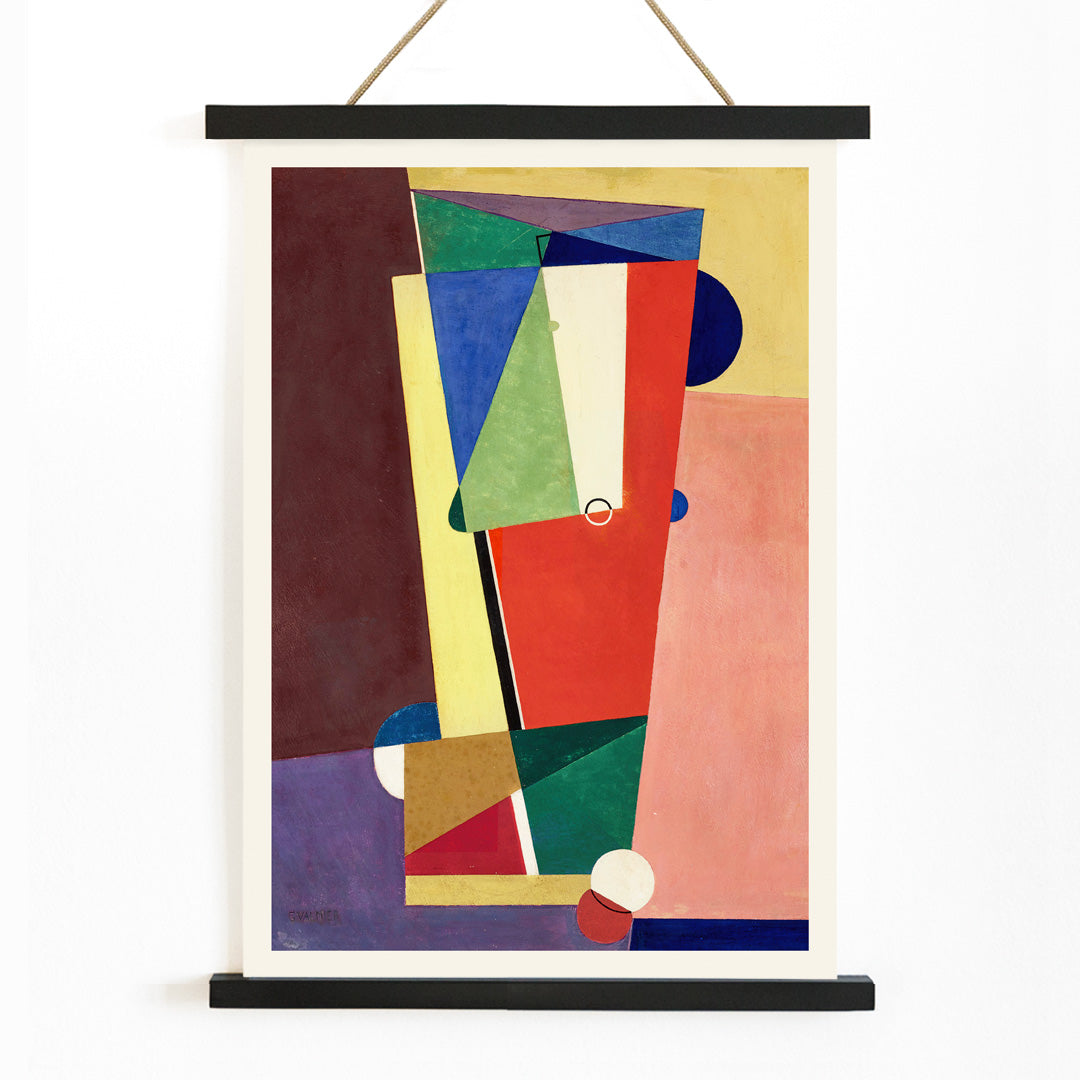
Created in 1921, this composition emerged during a time when artists were redefining painting as an exploration of rhythm, balance, and sensation rather than representation. In the wake of World War I, abstraction became a means to construct order and meaning from the fragments of modern life, echoing the innovations of contemporary music and urban experience. This work exemplifies Valmier's approach, inviting viewers into a dynamic interplay of shapes and energies rather than a narrative scene.
It stands as a testament to the era's belief in art's power to create structure and optimism out of chaos.
Style & Characteristics
The image is composed of interlocking geometric forms—curved and angular segments arranged in a lively, asymmetrical balance. Flat fields of color, including bold reds, yellows, blues, greens, and pinks, are juxtaposed with crisp edges and contrasting accents, lending the surface a constructed yet energetic feel. The composition's movement and vivid palette evoke the spirit of early abstract art, making it especially appealing to admirers of abstract wall art and the avant-garde.
The overall mood is vibrant and modern, with a sense of continuous motion and visual harmony.
In Interior Design
This poster serves as a striking focal point in living rooms, studios, or home offices where color and structure are desired. It complements mid-century furnishings, minimalist interiors, and spaces inspired by Bauhaus design. On white or light neutral walls, the artwork appears crisp and luminous; on warmer backgrounds, it takes on a more intimate, gallery-like atmosphere.
For a cohesive display, pair it with other minimalist art prints and select a simple frame that highlights the geometric composition.