




-

"Very nice Posters. The quality is amazing and we received it very quickly !"
-

"A shop to visit absolutely. Huge selection of posters. We spent more than an hour there !"
-

"Perfect to find gift. Price are very good. An they can frame and pack it on site"
About the Artist
A poised cyclist makes the surviving credit to J. & Co. Aberle worth following. The firm is named as the maker of Achtung Möve, dated 1902, yet the attribution does not identify an individual illustrator. More specific history appears in the printed advertisement: the Thüringische Maschinen und Fahrrad-Fabrik Walter & Co. in Mühlhausen supplied Möve bicycles, while Richard Hoffmann represented the brand in Breslau. Those commercial details anchor the vintage poster in a real sales network. As a fine art print today, it preserves the link between a Thuringian factory and customers seeking modern personal transport.
The Artwork
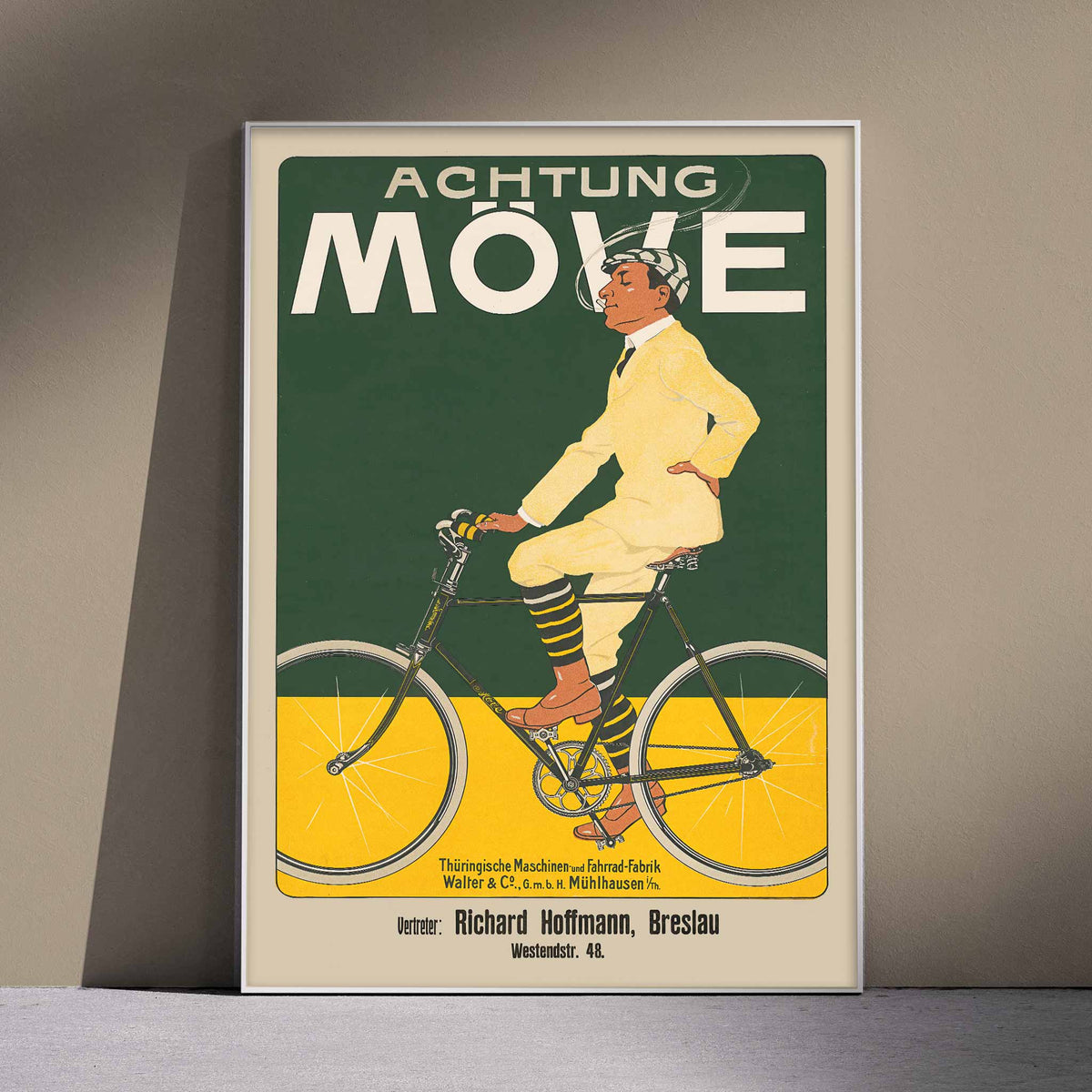
Achtung Möve sounds like a street call, but its purpose was invitation: remember the Möve name and ask the Breslau representative about a bicycle. Issued in 1902, the advertising poster addressed a market in which cycling promised independent movement as well as public visibility. The rider therefore functions less as an athlete than as an imagined customer, presenting bicycle ownership as a marker of confidence and means. Factory and dealer information complete the route from aspiration to purchase. Seen as a vintage print, the advertisement records how early bicycle marketing joined practical transport to the social appeal of appearing thoroughly modern.
Style & Characteristics
Cream lettering fills the upper field, forcing the eye around the striped cap before it reaches the face of the rider. His pale yellow suit cuts across the dark green ground. Bands of black and yellow pull the gaze down his stockings toward rust-colored shoes. One hand settles on the handlebar while the other rests at his hip; the cyclist looks staged rather than hurried. Fine spokes open over the bright yellow band, while cropped wheels press toward both sides of the vertical poster. As wall art, a fine art print preserves the strong outlines and direct force of the original advertisement.
In Interior Design
Place this cycling poster above a narrow oak console in a sunlit entrance hall. The dark green field makes the surrounding wall appear deeper, while the yellow strip near the wheels warms the first view inside. A slim black frame repeats the bicycle tubing without competing with the oversized cream lettering. Leave the console otherwise bare, giving the seated rider and broad typography room to command the passage. Used as wall art, the vertical format suits the confined width above the furniture and gives restrained home decor a precise reference to cycling culture in 1902. Each arrival passes beneath the sideways gaze of the rider.