


You may also like
-

Static and dynamic of the human body 1 Poster
Alexander Rothaug · 1933 · Analytical figure-study poster featuring a male body with geometric guides on beige
Poster from 69 kr · Framed from 122,67 kr
-

The human body Poster
Augé and Claude · 1900 · Antique anatomical scientific print presenting the human figure with labeled study diagrams
Poster from 69 kr · Framed from 122,67 kr
-

Human Skeleton Poster
Institute of Liepzig · 1900 · Detailed human skeleton scientific print with crisp linework on warm beige paper
Poster from 69 kr · Framed from 122,67 kr
-

Girl and Death Poster
Karl Wiener · 1941 · Surreal memento mori poster featuring a young woman with skeletal silhouette in blue-black tones
Poster from 69 kr · Framed from 122,67 kr


-

"Very nice Posters. The quality is amazing and we received it very quickly !"
-

"A shop to visit absolutely. Huge selection of posters. We spent more than an hour there !"
-

"Perfect to find gift. Price are very good. An they can frame and pack it on site"
About the Artist
Alexander Rothaug was an Austrian artist active in the early twentieth century, known for his precise draftsmanship and a deep engagement with the human figure. Trained in the academic tradition, Rothaug worked during a period when classical ideals were being reinterpreted through the lens of modern science and movement. His work reflects the era’s fascination with anatomy, athleticism, and the study of the body as both an artistic and scientific subject.
Rothaug’s figure studies, such as this one, were valued by artists and students seeking to master the fundamentals of proportion and gesture. His approach bridges the gap between traditional atelier training and the evolving interest in dynamic form that characterized early twentieth-century art.
The Artwork
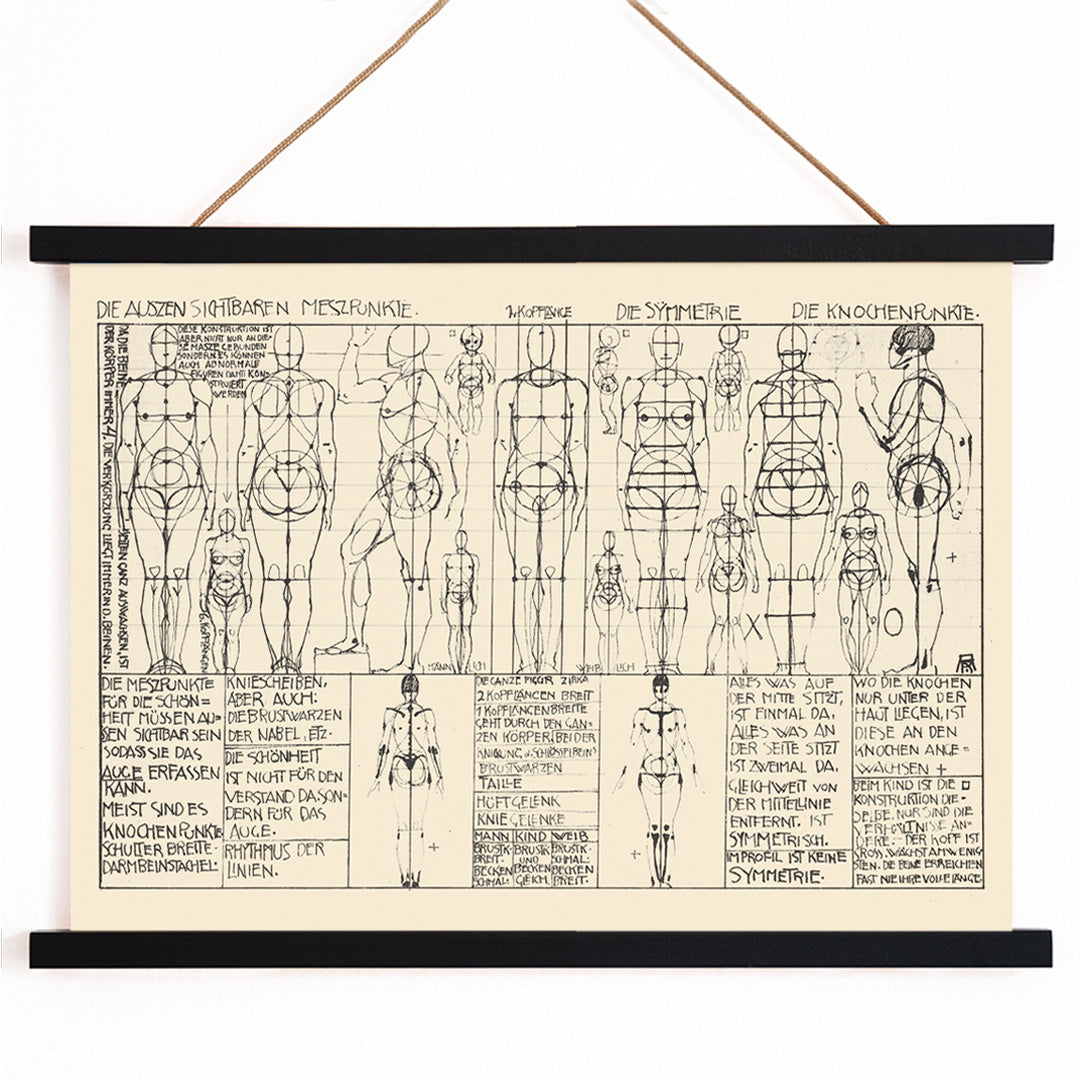
Created in 1933, this piece titled Static and dynamic of the human body 2 exemplifies the educational figure studies popular in art academies and studios of the time. Rather than focusing on individual identity, the artwork explores how the human body can be understood through contrasting poses—one static, the other in motion. This analytical approach reflects broader cultural interests in physical education, sports, and the mechanics of movement during the interwar years.
Such studies were essential tools for artists and educators, helping to illustrate the principles of balance, rotation, and anatomical structure. The print fits naturally within our science wall art and black and white prints collections, where observation and clarity are central themes.
Style & Characteristics
The composition features two nude male figures, one standing calmly and the other twisting in a dynamic pose. Executed in fine black lines on a warm beige background, the drawing emphasizes anatomical accuracy, contour, and the interplay of stillness and movement. Subtle shading and varied line weight lend depth without distracting from the instructional clarity of the image.
The overall mood is contemplative and disciplined, evoking the atmosphere of a classical artist’s studio. The restrained palette and precise rendering make this print appealing to admirers of minimalist and vintage art alike.
In Interior Design
This anatomical scientific print brings a thoughtful, scholarly presence to studies, creative workspaces, or bedrooms. Its understated elegance complements minimalist, modern, or classic interiors, especially those that appreciate timeless subjects and subtle color schemes.
For a harmonious gallery wall, pair it with other classic art prints or minimalist posters, using simple black or natural wood frames to echo the artwork’s refined aesthetic. It is a sophisticated choice for artists, designers, and anyone drawn to the enduring beauty of anatomical studies.