




-

"Very nice Posters. The quality is amazing and we received it very quickly !"
-

"A shop to visit absolutely. Huge selection of posters. We spent more than an hour there !"
-

"Perfect to find gift. Price are very good. An they can frame and pack it on site"
About the Artist
For Henri Matisse, a piece of cloth could become the starting point for a painting. He grew up in Bohain, a textile town in northern France, and later gathered fabrics and garments that reappeared throughout his studio practice. Romanian embroidered blouses became a recurring fascination, offering him a way to explore the relationship between the human figure and decorative art. The Romanian Blouse shows how closely he attended to textiles without treating them as mere accessories. As a fine art print, the portrait preserves that emphasis on dress: the garment carries as much expressive weight as the face.
The Artwork
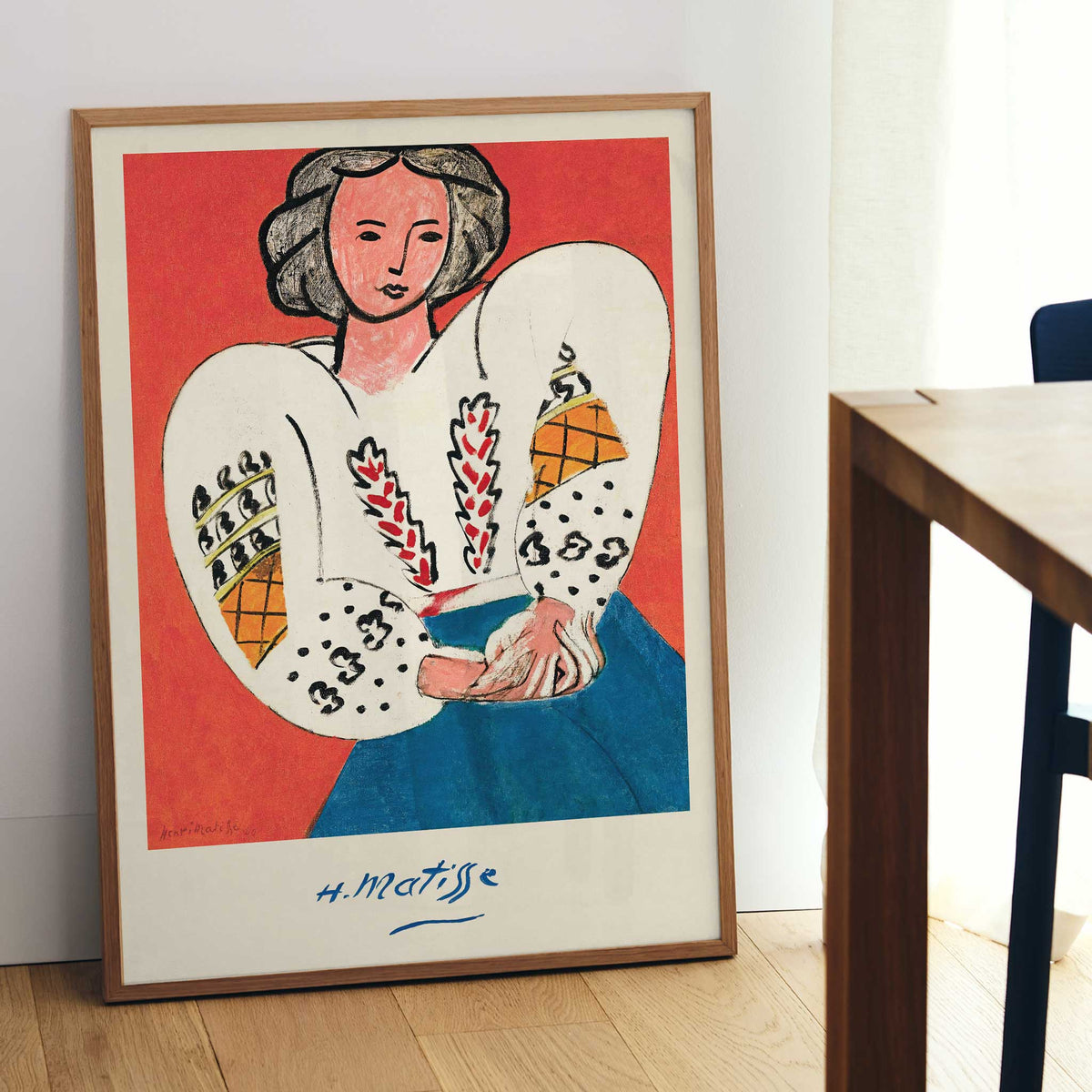
For Matisse, the Romanian blouse was more than a costume to record. He returned to the subject in Nice, where he made this painting in 1940 amid sustained experiments with the figure. Instead of presenting embroidery as an ethnographic specimen, he treated a regional textile tradition as a source for modern painting. Photographs of successive stages of the canvas document how extensively he revised it before reaching the version reproduced in this poster. Those changes give the work a history beyond its subject: a portrait became a long conversation between inherited craft and modernism.
Style & Characteristics
The enormous white sleeves announce themselves first, swelling against a red ground that seems to press forward around the figure. Black marks skip across the fabric, while orange lattice panels interrupt the sleeves. Two embroidered sprigs climb the chest in red and black. Below, overlapping hands rest above a deep blue skirt, their slender fingers contrasting with the generous sweep of the blouse. The tilted head and lightly drawn features soften those emphatic shapes. A pale lower margin holds a blue Matisse signature, giving this vertical poster a distinct visual pause beneath the portrait.
In Interior Design
Imagine this art print above a low walnut sideboard in a dining room, where late afternoon light falls across the wood and warms the red ground. A single cream ceramic bowl below echoes the broad sleeves, letting the embroidery supply the pattern instead of surrounding the picture with more ornament. In a slim black frame, the portrait stays visible from the table, and its folded hands offer a quiet pause during dinner. As wall art, the print gives the room a connection to modernism, while its saturated colour keeps the home decor from feeling subdued.